Walking to Find
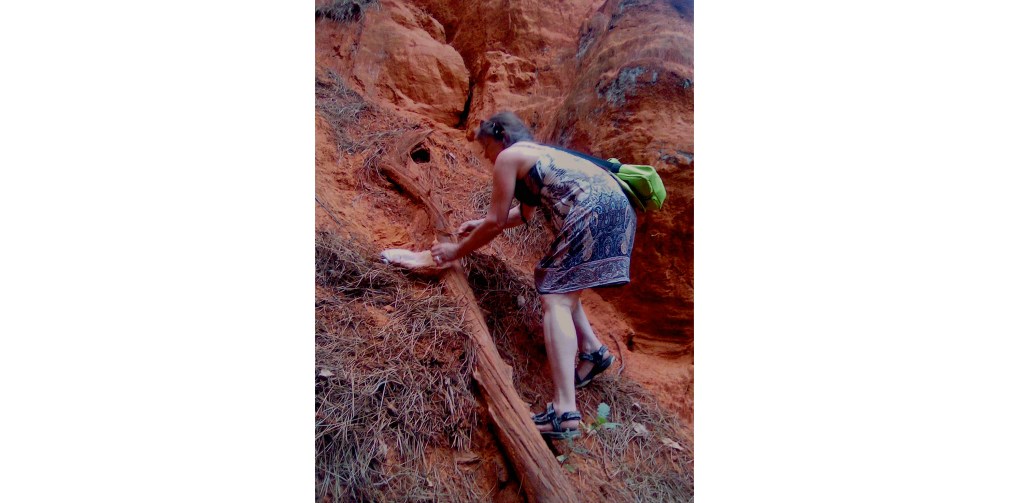
My work rarely starts in the studio. It starts on a path, on foot, often with no particular aim, in landscapes close to home, sometimes farther afield, wherever my travels take me.
I’m not looking for a spectacular place: I’m looking for whatever, one day, catches my attention.
It might be a pebble, a branch, a piece of bark, a plant by a stream. Nothing rare in itself. But something in its colour, its texture, or the way it sits there, stops me. I crouch down and look, for a long time. I identify it when I can.
This scouting, these walks, these identifications are not a prelude to the work: they are fully part of it.
When I decide to gather something, I do so with restraint. I take only what I need, in small quantities, taking care not to damage the place or what surrounds it. Gathering with restraint is first of all a matter of looking: knowing when to stop, to leave things where they are, to come back later. I also buy some materials from time to time; I don’t hide it, it is part of the trade too.
Putting it to the test in the studio
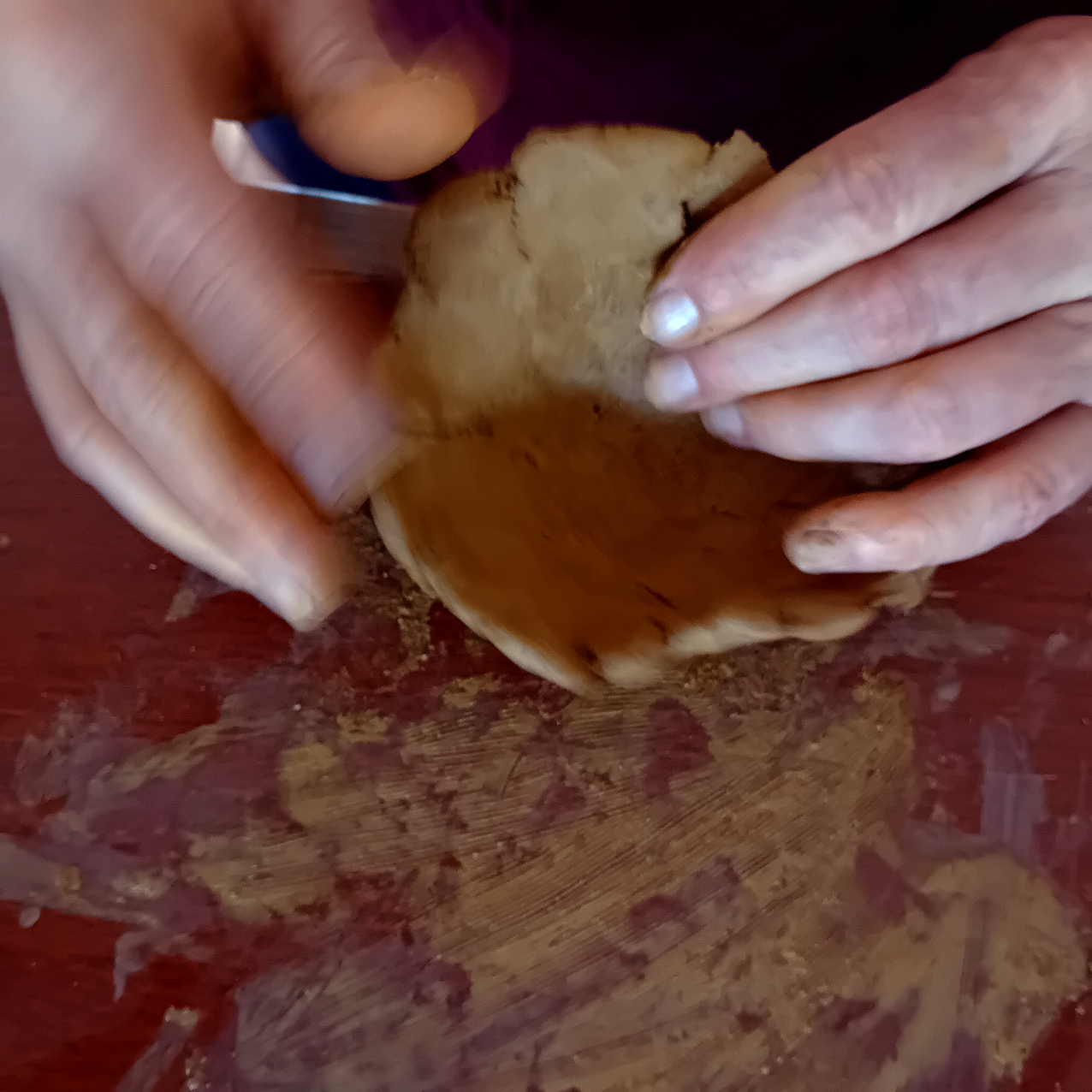
Back home, the samples are put to the test. I grind, I let things macerate, I try binders, I mix. Some materials give a rich, deep paint paste; plants, for their part, can become paper pulp. Other substances give nothing: they resist, change colour, deteriorate. That is an essential part of the process, and it teaches me as much as the successes do.
After these trials, I often go back to the place. By then I know what I am looking for, in what quantity, and exactly where. This back-and-forth between nature and studio creates a dialogue: the landscape answers the studio, and the studio teaches me to look more carefully at the landscape.
In this work, I refuse petroleum derivatives. I don’t make a manifesto of it: it is a choice of practice, which I prefer to show through gesture and material rather than through words.
What scouting does to the work
When you look at one of my paintings or sculptures, you see a result. What you don’t see are the kilometres, the hesitations, the materials set aside and those I kept.
Yet it is all there, in the colour, in the grain, in the modest scale of the pieces.
Walking to find means accepting that you won’t master everything: the material sets its limits, the landscape its seasons, and the work is born of that negotiation.
It is also, for me, a way of working in keeping with what I am trying to say, without needing to say it.